Meme coin trading can turn a small stake into six figures when you treat it as a risk-first process rather than a lottery ticket
You can order the same kind of articles for your own video to boost it on YouTube and Google. Just message the Telegram bot @sat_sit_bot. It writes articles around your video, embeds the video and publishes them on popular niche websites (no ads). Your first 50 articles are free.
· based on the channel Orangie Web3
Key takeaways
- A meme coin is a token whose price is driven by community attention and narrative, not by cash flow or fundamentals.
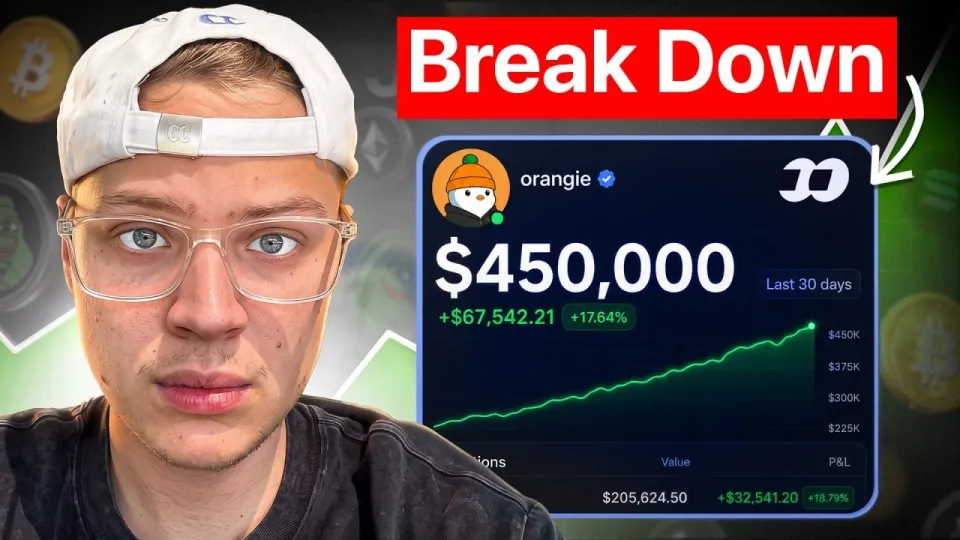
- In the video "How I Made $450,000 Trading Memecoins in 30 Days," the Orangie Web3 channel documents a six-figure run over a single month on Solana-style meme coins.
- The strategy is asymmetric: many small positions that can go to zero, a few that multiply, and strict rules on when to take profit.
- Most losses come from buying after a vertical candle, ignoring liquidity, or sizing a single bet too large for the bankroll.
- Tools named in the video description include a paid trading group on Whop and the FOMO trading platform.
A meme coin is a cryptocurrency with no product, revenue or roadmap behind it — its price is set almost entirely by attention, community and narrative. Trading them profitably is less about predicting which joke goes viral and more about position sizing, speed and taking profit before the crowd leaves. In the video "How I Made $450,000 Trading Memecoins in 30 Days" from the Orangie Web3 channel, that approach is documented over a single month, and the paid trading group behind it is available through the Kaizen Group checkout on Whop.
What a meme coin actually is and why the niche moves so fast
A meme coin is a token launched with little more than a name, a logo and a story, and its value depends on how many people want to hold that story at the same time. Dogecoin is the ancestor of the category, but the modern version lives mostly on Solana, where launchpads let anyone create a token in minutes and a bonding curve pushes it to a public exchange once a market-cap threshold is reached.
That structure explains the speed. There is no earnings report, no unlock schedule to model and no team to diligence, so the only inputs are liquidity, holder distribution and social momentum. A coin can go from a few thousand dollars of market cap to tens of millions in hours, and back to near zero just as quickly. The people who make money consistently are not the ones who predict the winner — they are the ones who survive the losers.
The mechanics behind a $450,000 month
The headline result in the Orangie Web3 video comes from a portfolio approach: many small bets, a handful of large winners, and profit taken in tranches instead of held for an imaginary top. The exact trades are not the point; the repeatable structure is.
- Size every position so zero is survivable. If a single coin can wipe out the week, the position is too big. Traders who scale in this niche typically risk a small fixed percentage of the bankroll per idea.
- Enter early or not at all. Buying after a token has already printed a vertical candle means buying the exit liquidity of someone faster. Entries are taken during the launch phase, on the first pullback, or on a confirmed reclaim of a key level.
- Take profit in pieces. Selling 20–30% on the first double, another chunk on the next leg, and leaving a runner with a stop at break-even converts paper gains into real ones.
- Cut dead positions fast. A meme coin that stops making higher lows while the narrative cools rarely comes back; the capital is better used elsewhere.
- Expect a low hit rate. A month that ends at $450,000 can still contain dozens of losses. The distribution is heavily skewed, and one or two outsized wins carry the whole result.
Tools, platforms and the workflow around a trade
The tooling matters as much as the thesis, because execution speed decides the price you get. The video description points to the FOMO trading platform (https://fomo.family/r/orangie) as the interface used for finding and trading coins, alongside a Discord community (https://discord.gg/memecoins) where calls and setups are shared.
A practical workflow looks like this:
- Screening: filter new launches by liquidity, holder count and whether the dev wallet still holds a large share.
- Contract check: confirm the token is not a copy of a known scam, that mint authority is revoked and that trading is not paused.
- Chart context: look at the bonding-curve graduation point and the first consolidation, not just the percentage gain on the day.
- Execution: set slippage deliberately — too low and the order fails, too high and you pay a hidden tax to snipers.
- Journaling: record entry, exit and the reason for each, which is how patterns become rules instead of hunches.
Where meme coin traders actually lose money
Most losses in this niche come from behaviour, not from bad luck. The most common failure is buying a green candle because it is moving, then holding through the reversal in the hope of a bounce that never comes. A second is ignoring liquidity: a token with a thin pool can show a large market cap on paper while any real sell order craters the price.
Other recurring traps include chasing coins that have already graduated and run 10x, aping into launches where a single wallet holds most of the supply, and treating a small account as a reason to take maximum risk. The pattern is consistent — traders who lose their first deposit usually did so on one oversized position rather than twenty small ones. The recovery story in the comments of the video, where a trader lost most of a $100 stake and then tripled what was left on a single coin, is the exception, not the plan.
Common questions from newer traders, answered
Newer viewers of the channel repeatedly raise the same concerns: the pace of explanation, the size of the starting bankroll, and whether the results are reproducible. On speed, the practical answer is to watch a walkthrough once for the overall flow and a second time with a notepad, pausing at each entry and exit. On bankroll, the honest position is that a few hundred dollars is enough to learn the mechanics but not enough to expect a six-figure month — the percentage returns matter, not the dollar amount.
On reproducibility, the $450,000 figure reflects a specific month, a specific market and a trader with a large existing bankroll and a network of information. Copying the trade sizes without the bankroll, the tools and the experience is how accounts get destroyed. What transfers is the process: small risk per idea, early entries, staged profit-taking and a written record of every decision.
Useful links
- Kaizen Group access and checkout: https://whop.com/checkout/plan_GTFkEFh0JFpU8?a=orangie
- FOMO trading platform: https://fomo.family/r/orangie
- Discord community: https://discord.gg/memecoins
- Instagram: https://www.instagram.com/orangieyt/
Final thoughts on trading meme coins without blowing up
Meme coin trading is a game of asymmetric bets and disciplined exits, and the $450,000 month shown by the Orangie Web3 channel is best read as a case study in process rather than a promise of returns. The transferable lessons are unglamorous: keep each position small enough to lose, enter before the crowd, sell into strength in tranches, and keep a journal so the next decision is informed by data. Anyone starting with a small bankroll should expect tuition fees and treat survival as the first milestone. For traders who want the full workflow and community behind the strategy, the Kaizen Group is accessible through the Whop checkout linked in the video.
Source: How I Made $450,000 Trading Memecoins in 30 Days · Markdown version
Questions & answers
How much money do you need to start trading meme coins?
A few hundred dollars is enough to learn the mechanics of buying, selling and managing slippage, but it will not produce a six-figure month. What matters at small size is the percentage return and the habit of keeping each position small enough that a total loss does not end the experiment.
Are meme coin gains like the $450,000 month realistic for a beginner?
No. That result came from a large existing bankroll, a network of information and a single favourable month on Solana-style launches. A beginner should expect a low hit rate and frequent losses, and should judge progress by whether the process is repeatable rather than by the size of one win.
What is the biggest risk when trading meme coins on Solana?
Liquidity and supply concentration. A token can show a large market cap while a thin pool means any real sell order collapses the price, and a launch where one wallet holds most of the supply can be dumped on buyers at any moment. Checking the contract and holder distribution before buying is basic hygiene.
When should you take profit on a meme coin?
Selling in tranches works better than waiting for a top: taking a portion on the first double, more on the next leg, and leaving a runner with a stop at break-even. Meme coins rarely give a second chance at the high, so converting paper gains into realised ones is the core skill.